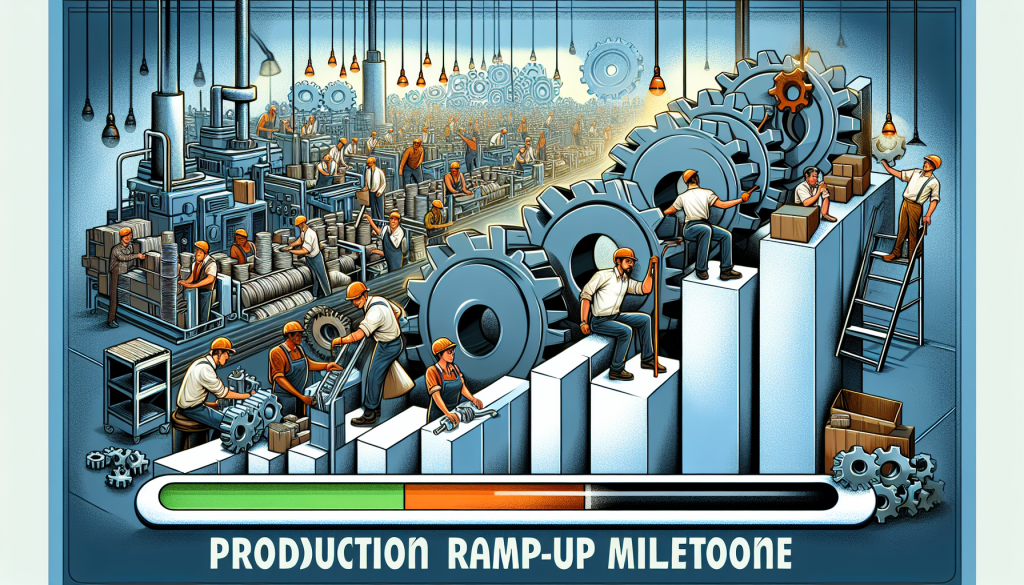
The industrial landscape is experiencing a seismic shift as companies increasingly rely on strategic production ramp-up milestones to optimize their resource development processes. These carefully planned benchmarks are no longer just internal metrics—they’ve become powerful catalysts that drive efficiency, reduce costs, and accelerate time-to-market across diverse industries. From lithium mining operations to semiconductor manufacturing, organizations that master the art of milestone-driven production scaling are emerging as clear market leaders.
Accelerating Time-to-Market Through Strategic Milestone Planning
Modern resource development projects face unprecedented pressure to deliver results faster than ever before. A well-structured production ramp-up milestone framework enables companies to break down complex scaling processes into manageable, measurable phases. Leading manufacturers report reducing their time-to-full-production by an average of 23% when implementing systematic milestone approaches compared to traditional scaling methods. These milestones serve as critical checkpoints where teams can assess equipment performance, workforce readiness, and supply chain stability before proceeding to the next phase. The semiconductor industry exemplifies this approach, with major fabrication facilities using detailed production ramp-up milestone schedules to coordinate the intricate process of bringing new chip manufacturing lines online while maintaining quality standards.
Data-Driven Resource Allocation and Risk Mitigation
The integration of advanced analytics into production ramp-up milestone planning has transformed how companies allocate resources and manage operational risks. By establishing clear performance indicators at each milestone, organizations can make informed decisions about capital deployment, staffing levels, and equipment investments. Recent industry analysis shows that companies utilizing data-driven milestone frameworks experience 31% fewer cost overruns during production scaling phases. Mining companies, particularly those developing critical mineral projects, have embraced this methodology to navigate the complexities of bringing new extraction sites to full capacity. Each production ramp-up milestone incorporates real-time data on equipment efficiency, ore grade consistency, and environmental compliance metrics, enabling project managers to adjust strategies before minor issues escalate into major setbacks.
Technology Integration and Automation Scalability
The convergence of Industry 4.0 technologies with traditional production scaling has redefined what constitutes an effective production ramp-up milestone. Smart sensors, predictive maintenance systems, and automated quality control measures now provide unprecedented visibility into every aspect of the scaling process. Manufacturing facilities implementing IoT-enabled milestone tracking report 40% improvement in identifying bottlenecks before they impact production targets. These technological capabilities allow teams to establish more granular milestones that account for equipment learning curves, operator training progression, and supply chain optimization. Battery manufacturing plants, for instance, use sophisticated milestone frameworks that track cell quality consistency, throughput rates, and energy efficiency as production volumes increase from pilot-scale to commercial capacity.
Cross-Industry Applications and Future Implications
The versatility of production ramp-up milestone methodologies has led to widespread adoption across previously disconnected industries. Pharmaceutical manufacturers use milestone-driven approaches to scale biologics production while maintaining stringent regulatory compliance. Renewable energy developers apply similar frameworks when bringing large-scale solar panel and wind turbine manufacturing facilities online. Even service-oriented sectors like data center operations have adapted these principles to manage the complex process of scaling computing capacity while maintaining performance standards. The success of these applications suggests that milestone-driven resource development will become increasingly standardized, with industry-specific benchmarks emerging to guide best practices.
As global supply chains continue to evolve and competitive pressures intensify, the strategic implementation of production ramp-up milestones represents more than operational optimization—it’s become a fundamental differentiator between market leaders and followers. Organizations that embrace this methodology position themselves to respond more effectively to market opportunities, regulatory changes, and technological disruptions. The companies investing in sophisticated milestone frameworks today are building the operational resilience and agility that will define success in tomorrow’s resource development landscape.