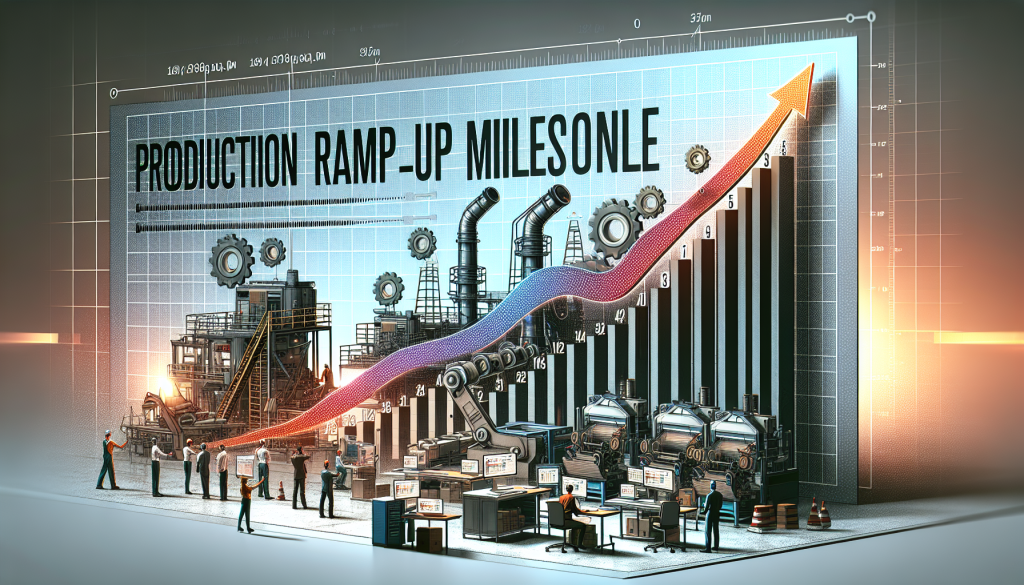
The mining and manufacturing industries are experiencing a fundamental shift in how they approach project development, with production ramp-up milestones emerging as critical indicators of long-term success. These carefully planned benchmarks are transforming how companies transition from construction to full operational capacity, fundamentally changing the landscape of resource development projects worldwide.
A production ramp-up milestone represents a specific, measurable achievement during the critical phase when a project moves from initial production to target output levels. Unlike traditional approaches that often left this transition phase loosely defined, modern resource developers are implementing structured milestone frameworks that provide clear visibility into operational progress and financial performance.
The transformation is particularly evident in lithium mining operations, where companies are setting quarterly production ramp-up milestones to meet growing battery demand. Recent data from major mining operations shows that projects with clearly defined production ramp-up milestone schedules achieve target capacity 23% faster than those without structured frameworks. This acceleration translates directly into improved cash flow timing and enhanced investor confidence.
Manufacturing facilities are equally benefiting from this milestone-driven approach. Semiconductor fabs, for instance, now establish production ramp-up milestones that account for yield optimization, equipment calibration, and workforce training. Each production ramp-up milestone serves as a checkpoint where teams evaluate performance metrics, adjust processes, and communicate progress to stakeholders.
Financial Impact and Risk Mitigation
The financial implications of effective production ramp-up milestone management extend far beyond operational efficiency. Investment analysts are increasingly using these benchmarks to assess project viability and management execution capability. Companies that consistently meet their production ramp-up milestone targets typically see lower financing costs and stronger equity valuations.
Risk mitigation represents another crucial advantage of the milestone approach. By breaking down the ramp-up phase into discrete, measurable segments, project teams can identify potential bottlenecks early and implement corrective measures before they impact overall timelines. This proactive management style has become particularly valuable in complex resource development projects where delays traditionally cascaded through multiple operational phases.
The data supporting this transformation is compelling. Industry analysis reveals that projects utilizing structured production ramp-up milestone frameworks report 31% fewer cost overruns during the transition to full production compared to projects without such systems. Additionally, these projects demonstrate superior safety performance, with incident rates during ramp-up phases showing marked improvement when milestone-based monitoring is implemented.
Technology Integration and Future Developments
Advanced monitoring technologies are enhancing the effectiveness of production ramp-up milestone tracking. Real-time data analytics platforms now provide continuous visibility into key performance indicators, allowing project teams to assess progress against each production ramp-up milestone with unprecedented precision. Machine learning algorithms are even beginning to predict potential milestone delays based on early performance patterns.
The integration of digital twin technology is further revolutionizing how companies approach production ramp-up milestone planning. By creating virtual replicas of their operations, resource developers can simulate various ramp-up scenarios and optimize their milestone structures before physical implementation begins. This technological advancement is proving particularly valuable for complex mining operations and advanced manufacturing facilities.
Environmental considerations are also becoming integrated into production ramp-up milestone frameworks. Companies are establishing sustainability benchmarks alongside traditional production targets, ensuring that environmental performance standards are met at each phase of the ramp-up process. This holistic approach is increasingly important as regulatory requirements become more stringent and investor focus on ESG criteria intensifies.
The evolution toward milestone-driven resource development represents more than a procedural change—it reflects a fundamental shift toward data-driven, transparent project management that benefits all stakeholders. As markets continue demanding greater accountability and predictability from resource development projects, the production ramp-up milestone framework is becoming an essential tool for competitive advantage. Companies that master this approach are positioning themselves for sustained success in an increasingly complex and demanding operational environment.