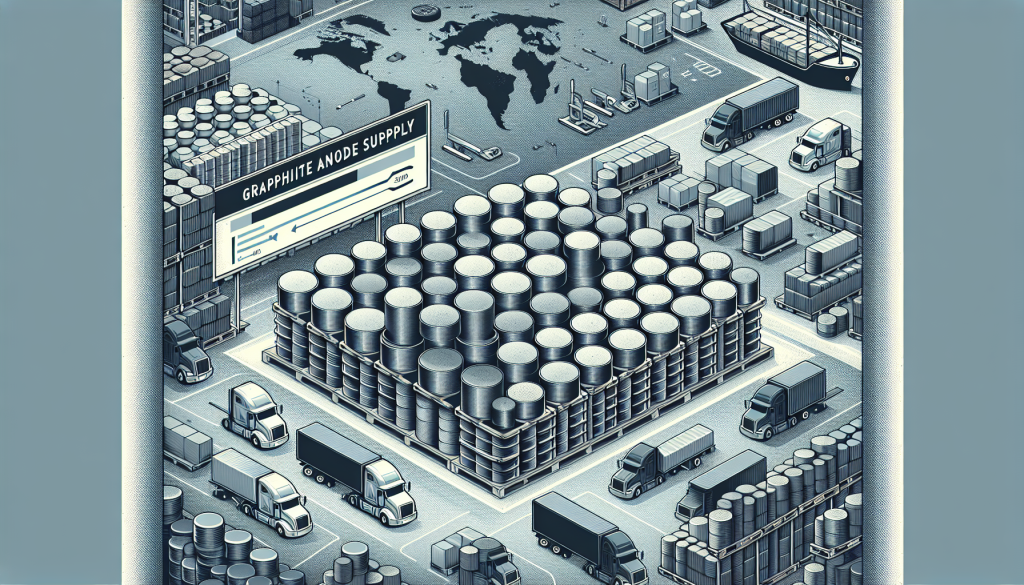
The global battery revolution is hitting an unexpected bottleneck that could reshape entire commodity markets. While investors have fixated on lithium’s wild price swings and nickel’s supply disruptions, a quieter crisis is brewing in the graphite anode supply chain—one that threatens to constrain battery production far more severely than any other materials shortage to date.
Graphite anodes represent the largest component by weight in lithium-ion batteries, typically accounting for 10-15% of total battery mass and serving as the critical negative electrode where lithium ions are stored during charging. Unlike cathode materials that grab headlines, graphite anode supply has operated in relative obscurity despite being absolutely essential for battery function. This oversight is now creating unprecedented market tensions as electric vehicle production scales exponentially.
The numbers paint a stark picture of impending scarcity. Current global graphite anode supply sits at approximately 1.4 million tons annually, with China controlling roughly 85% of production capacity. Meanwhile, projected demand for electric vehicles alone is set to consume over 2.8 million tons of anode graphite by 2030—a doubling of current supply that requires massive new mining operations and processing facilities that simply don’t exist yet.
What makes this supply crunch particularly acute is the specialized nature of battery-grade graphite. Not all graphite can serve as anode material. The graphite must be either natural flake graphite processed into spherical form or high-purity synthetic graphite produced from petroleum coke. Both processes are energy-intensive, technically complex, and dominated by Chinese manufacturers who have spent decades perfecting their production methods.
Recent geopolitical developments have amplified these supply concerns dramatically. New export restrictions and trade tensions have forced Western battery manufacturers to scramble for alternative graphite anode supply sources, often at premium prices. Tesla’s Gigafactory expansion plans, Ford’s Lightning production ramp-up, and General Motors’ Ultium battery rollout are all potentially constrained by graphite availability rather than the lithium shortages that typically make headlines.
Processing Bottlenecks Create Investment Opportunities
The graphite anode supply shortage stems from processing constraints rather than raw material scarcity. Natural graphite deposits exist globally, from Mozambique to Madagascar to Canada, but transforming raw graphite into battery-grade anode material requires sophisticated purification and spheronization facilities that take years to construct and commission.
This processing gap has created exceptional opportunities for companies developing integrated graphite anode supply chains outside China. Syrah Resources’ vertically integrated approach from Madagascar mining to Louisiana processing represents the type of strategic positioning that could capture enormous value as supply shortages intensify. Similarly, NextSource Materials and Northern Graphite are advancing projects that could provide critical supply diversification.
The economics are compelling for new entrants. Battery manufacturers are increasingly willing to pay premium prices for secure, long-term graphite anode supply contracts. Recent off-take agreements have locked in prices 40-60% above historical averages, with some contracts including automatic escalation clauses tied to battery production volumes. These pricing dynamics create robust cash flow projections for new graphite processing facilities.
Market Disruption Accelerating
The graphite anode supply crisis is accelerating faster than most analysts anticipated. Major battery manufacturers including CATL, LG Energy Solution, and Panasonic have all issued warnings about potential production constraints related to anode material availability. Some automotive manufacturers have already experienced production delays specifically attributed to graphite anode supply shortages rather than the semiconductor or other component issues that dominated recent supply chain discussions.
Technological developments in battery chemistry could either alleviate or exacerbate these supply pressures. While silicon-graphite composite anodes promise higher energy density, they still require substantial graphite content. Conversely, lithium metal anodes and solid-state batteries could eventually reduce graphite demand, but these technologies remain years away from commercial scale.
The strategic implications extend beyond individual company profits. Countries recognizing the critical nature of graphite anode supply are implementing industrial policies to secure domestic processing capacity. The U.S. Infrastructure Investment and Jobs Act specifically identifies graphite as a critical mineral, while European battery manufacturers are lobbying for similar supply chain security measures.
Smart investors positioning themselves in graphite anode supply chains today are likely capturing exposure to what could become the next major battery metals catalyst. As electric vehicle adoption accelerates globally and energy storage installations multiply, the companies controlling reliable graphite anode supply will hold the keys to battery production capacity. In a world transitioning rapidly toward electrification, that represents extraordinary strategic value waiting to be unlocked.