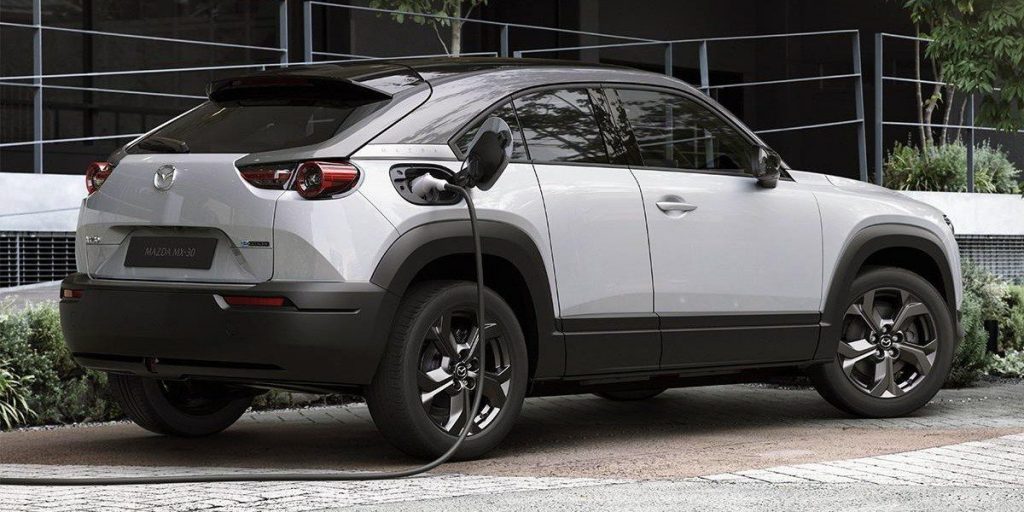
Mazda has one of the strangest and most controversial approaches to electric cars and we just learned something else about it: the automaker made its first electric car artificially slower “to feel more like a gas car.”
The Japanese automaker has historically been seen as lagging behind when it comes to electric vehicles.
They have yet to launch an all-electric car, and Mazda executives have often talked down electric car technology publicly in favor of hydrogen fuel cells.
But last year, Mazda finally unveiled their first EV; the MX-30.
It was received to mixed reviews due to its relatively small battery pack and range.
Last month, we reported on how Mazda wrongly says long-range EVs are worse for CO2 than diesel cars and that it doesn’t plan to manufacture any all-electric cars with big battery packs.
One thing that we missed from Mazda’s new MX-30 is that they not only made the battery pack smaller on purpose, but they also reduced the torque of the electric motor to match the acceleration of a gasoline car.
Autocar reported based on interviews with Mazda execs:
“Mazda’s engineers have also tuned the torque delivery of the MX-30’s electric motor to be less frenetic than is often the case with EVs, reasoning that they want the MX-30 to feel less like a dramatic change from a typical internal combustion engine vehicle.”
The MX-30 features a 35.5 kWh battery and a powertrain capable of delivering 105 kW (142hp) of power and 264 Nm (192 lb-ft) of torque. Range is quoted as 130 miles (~210km) for the European model, which is likely using the WLTP testing standard. This means EPA range will likely be lower, around 110-120 miles.
It is expected to accelerate from 0 to 60 mph in 9 seconds.